Seventy percent. That is a big figure. Almost three quarters of all people who comment or post online about not flying easily wish they had the same thing: a flight attendant sitting beside them, holding their hand.
“Holding hands is not part of it yet. But everything else a flight attendant can provide in terms of stability is now finally available, thanks to the latest research, for passengers who do not fly easily,” says Jens Daessler.
The German guy is the opposite of flight anxiety. He stays in the air for as long as he can. He has flown a lot, lived in many places around the globe and accompanied high-consequence individuals with flight anxiety on long-distance travels. What drives the German behavioral architect is strong.
“I cannot see how people who do not fly easily are treated as sick, mentally weak or low IQ,” Daessler says. “It is high time they can feel what I feel. Freedom in the air instead of panic.”
He did not just learn exactly what really helps. He also understood that almost all generic help is based on a working brain. Learn this. Do that. Remember not to think about this. Read up on turbulence. Tell yourself that flying is safe.
A panicking brain does not need a TED Talk.
It needs guidance.
Calm, strict words. Compact tasks that re-route raging fear-energy into something less destructive.
“This is not about removing fear,” says Daessler. It was never his aim to fight fear. “But if you manage to stay stable when the bumpy sky road is ahead, you have managed one thing: staying operational. You do not lose it. You do not show panic to other travelers. There is still fear, but you manage it, so you stay in control.”
That is the difference between being told to calm down and being given a way through the moment.
For decades, people with flight anxiety have been sent into the cabin with the same old baggage: breathing exercises, safety facts, turbulence explanations and a handful of re-assuring phrases. These things may sound reasonable before departure. But they are close to useless when the cabin door closes, the engines rise and the body decides that danger is everywhere.
The new science behind this is here now.
Five different fields of research have been examining humans and fear from different angles. When to act against panic. What action helps. What to avoid when the mind is overloaded. How people regain control in confined, high-pressure environments. Why the right instruction at the right moment can change the entire experience. Five core learnings - combined and adjusted to change the whole game. Finally.
“The science is now here,” Daessler says. “My job was to connect the threads and create a system whose components had already been tested successfully.”
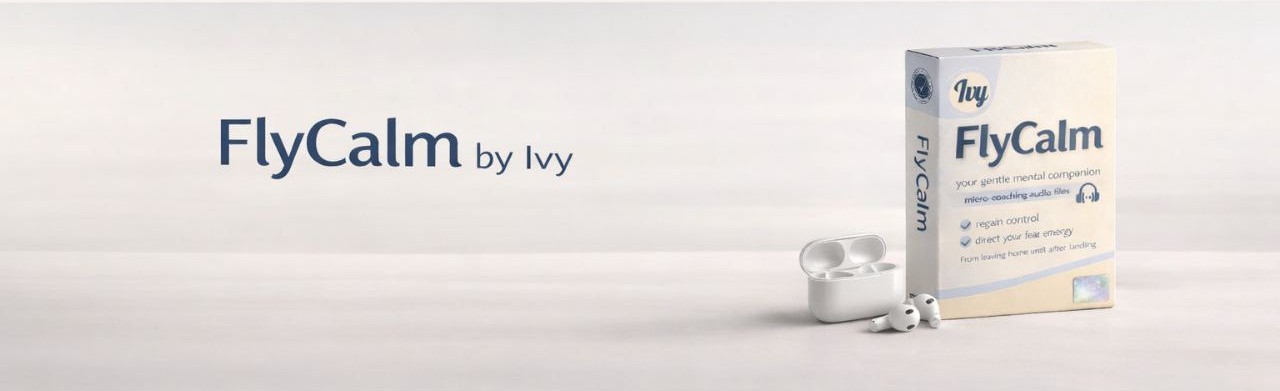
The result is FlyCalm, the first practical expression of a wider concept called Ivy. (As in: I've got you covered.)
It is built for acute pressure situations and begins with flight anxiety because the problem becomes brutally clear in an aircraft. Once the doors are closed, a passenger cannot simply walk out. They cannot find a quiet room. They cannot wait until their head works properly again. They need a firm hand. Right now. No thinking, no learning, no questions asked. (And nobody notices.)
The compact app works offline, on the ground and in the air. The concept starts the evening before a flight and ends right after touchdown. It is audio-only.
“When anxiety is high, you do not want to hold things in your hands,” Daessler says. “So we made it audio-only. You push the matching button and a real voice, no AI, starts guiding you about how to handle this exact situation.”
There is no explanation to work through while the body is already in alarm. No lecture about why wings can handle turbulence. No demand to count while breathing to become calm before help can begin.
The audio instructions take the hand of the passenger. They are built for the exact moments of the trip: the night before, the drive to the airport, boarding, takeoff, turbulence, descent and landing. The traveler in seat 23A does not have to understand fear. They only have to get through the next moment. And the next.
For the person who has spent years hiding tears at the gate, gripping an armrest through takeoff or praying that nobody notices what is happening inside, that changes the whole life.
The next flight does not have to be the same nightmare again.